
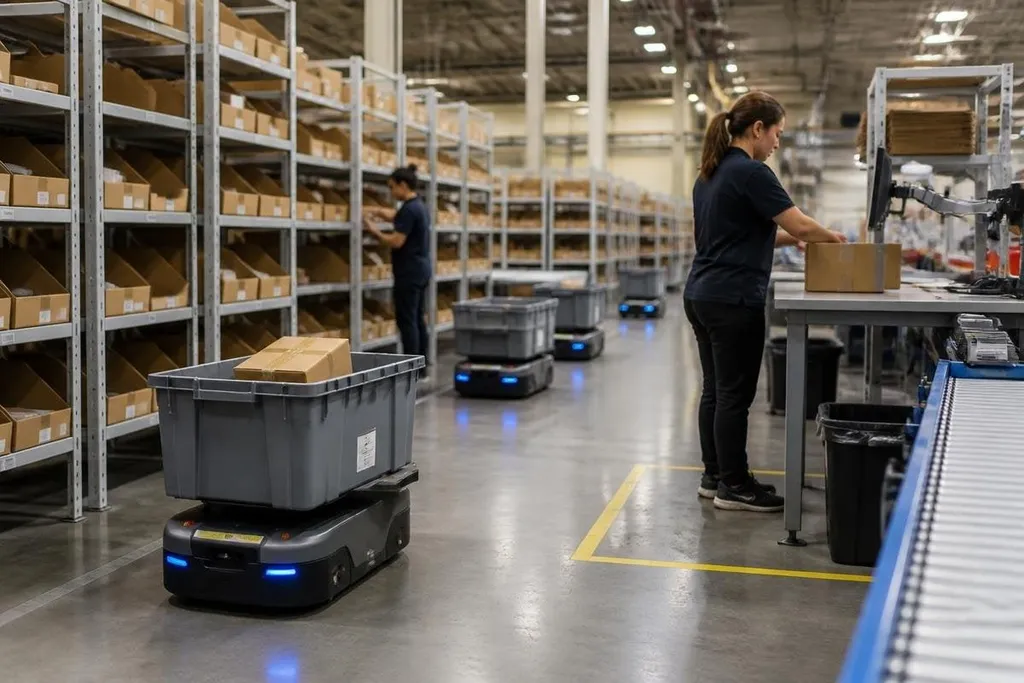
Same-day delivery depends on minutes inside the warehouse, not only on the courier outside it. Robotics cuts those minutes by moving goods, sorting orders, and handing work between stations with less walking and waiting.
- Mobile robots bring shelves or bins to workers.
- Robotic arms sort parcels and handle repeatable picks.
- Software links orders, routes, storage, and dispatch.
The warehouse work that takes time
A customer order passes through several steps before it reaches a vehicle. Someone must find the item, carry it to a packing bench, check the order, pack it, sort the parcel, and move it to the right dispatch area.
People can do each task, but walking often takes a large share of a shift. A worker may spend minutes crossing the building for one item, then repeat that trip for the next order. Those small delays spread across thousands of orders.
Robotics changes the layout of the work. An autonomous mobile robot, or AMR, can carry a shelf, tote, or cart to a worker. The worker stays at a station and picks the item when the system sends it there.
That arrangement is known as goods-to-person picking. It matters for same-day delivery because the order spends less time waiting for a worker to find its storage location.
Where robots remove delays
Robotic arms handle tasks that need the same motion many times. A picking arm may lift items from a bin, place them into a tote, or move parcels onto a conveyor. Cameras and force sensors help the arm adjust when an item shifts or a box is not where the system expects it.
Conveyors and sortation systems carry parcels between work areas. Divert points send each parcel toward packing, storage, or dispatch. The system can keep parcels moving while people deal with exceptions such as damaged packaging or an item that cannot be identified.
Software ties these machines together. It receives the order, checks stock, chooses a storage location, sends a task to a robot, and records the result.
The value comes from that chain working as one process, since a fast picking station cannot help if packing or dispatch leaves orders waiting.
A delivery robot’s speed matters only if it completes the route and hands over the order without staff taking over. Robot24.com's delivery robotics reports can tie that claim to the robot, route, order count, and handoff result.
The limits behind the promise
Robots work best when the warehouse has repeatable tasks, known storage locations, and goods that machines can handle. Irregular items, soft packaging, poor labels, and crowded aisles still create work for people.
A robot also needs safe routes, charging time, maintenance, and a way to stop when its sensors detect a person or an object. Those needs add planning work before the first order moves through the system.
The delivery cutoff depends on the whole operation. If a robot moves a tote quickly but the packing station runs short of boxes, the customer sees the same delay. Same-day delivery is a chain, and the slowest handoff sets the pace.
I'd start with the task that creates the longest wait, then test whether a robot fixes that wait without adding a new one.
A practical buying checklist
Before choosing a robotic system, check these points:
- Map the delay: Measure walking, picking, packing, and dispatch time separately.
- Check the goods: Record item sizes, weights, surfaces, packaging, and labels.
- Plan exceptions: Decide who handles blocked routes, failed picks, damaged boxes, and missing stock.
- Test the handoff: Confirm that the robot, warehouse software, packing bench, and conveyor exchange order data correctly.
- Price the support work: Include charging, spare parts, maintenance, training, and safety checks.
- Set the cutoff: Link robot capacity to the time vehicles leave, not to a lab task rate.
The useful measure is not how quickly one robot moves. It is how many complete orders reach dispatch before the same-day cutoff, and that number still depends on every handoff after the robot finishes its part.